
Ultrasound and Regional Anesthesia


INTRODUCTION
The main objective of locoregional anesthesia is to achieve high efficacy and safety. The transition from the technique of paresthesia to nerve stimulation set a milestone for nerve blockades. Though this transition signifi cantly reduced the risk of nerve and blood vessel damage, this risk still cannot be avoided completely.
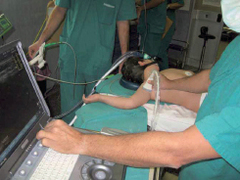
However, this risk could be reduced even further by the introduction of ultrasound as a guidance to locate the nerves. This technique with real-time visualization of the needle during its placement makes it the safer approach. Currently in the literature, no data can evidence the advantages of the ultrasound technique over the nerve stimulation technique.
Thus the authors recommend the use of both techniques - especially to those colleagues, who for the first time perform a nerve block under ultrasound guidance. It will not only serve as an educational tool, the muscular twitch induced by nerve stimulation will also help to confi rm that the needle has been placed exactly near the nerve.
We thus agree with Vincent Chan whose opinion is expressed in his report in the ASRA Newsletter 2007:
“It is important to emphasize that ultrasound and nerve stimulation techniques are not mutually exclusive. On the contrary, the two techniques complement each other and each has its own strengths and weaknesses. For this reason, residents should be encouraged to learn both techniques. Only time will tell which one of these techniques will become the method of choice for nerve localization pending results of future outcome studies and clinical experience.”
It is also advisable to use the needles normally used for nerve stimulation and not „normal“ needles, as these are extremely sharp, and it is much more likely that vessels or nerves are injured with them; such needles should be reserved for the more „experienced“ anesthesiologists. The present handbook serves as a guide to those colleagues who are enthused by this new and fascinating technique. It is nevertheless imperative to attend specifi c courses that impart the essential knowledge on this technique and it is also important to acquire in-depth training at hospitals that have ample experience with this technology.
Authors:
Giorgio IVANI
Chairman Division of Pediatric Anesthesiology and Intensive Care Unit
Regina Margherita Children‘s Hospital
Turin, Italy
President of ESRA 2006-2009
Valeria MOSSETTI
Medical Staff
Division of Pediatric Anesthesiology and Intensive Care Unit
Regina Margherita Children‘s Hospital
Turin, Italy
Alfonso FAUSTO
Medical Assistant
Department of Radiology at IRCCS Policlinico San Donato
Italy